

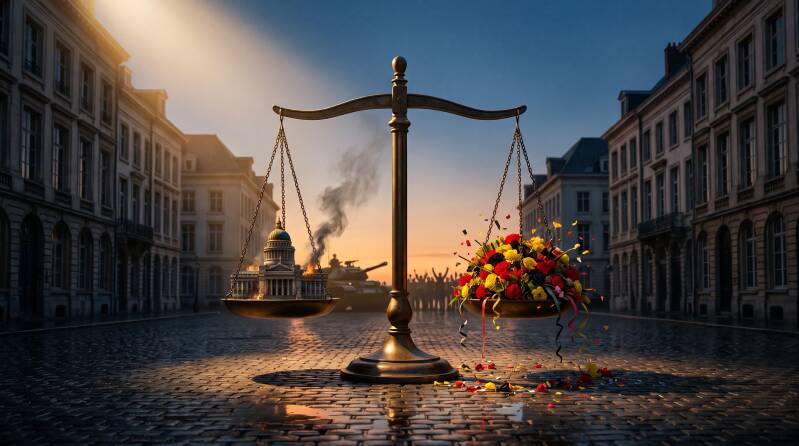
The liberation of Brussels ended more than four years of German occupation of the Belgian capital. On Sunday evening, 3 September 1944, shortly before 8 p.m., the first tanks of the British Guards Armoured Division rolled into the city while the Palace of Justice was still burning. The joy was immense, yet the initial weeks of freedom also revealed the fragile boundary between justice and revenge.
Maria De Bel is thirteen. On Sunday, 3 September 1944, she walks with her older brother to her sister's house. Flames and smoke hang over the city. The dome of the Palace of Justice is on fire. Her brother tells her not to scream. Closer to home, on the Chaussée de Louvain, Maria watches German soldiers leave. On foot, on bicycles, loaded with whatever they can carry. Maria told this story eighty years later to the Brussels broadcaster BX1. Her memory is small and precise: flames, a brother keeping her quiet, and soldiers with too much luggage. Freedom rarely begins with a brass band. It begins with confusion. A few hours later, the tanks roll in.
3 September 1944: the Guards Armoured Division enters Brussels.
On 3 September 1944, the British Guards Armoured Division liberated Brussels after advancing more than a hundred kilometres in a single day. The vanguard of the Welsh Guards reached the city shortly before 8 p.m. The Guards Armoured Division was a British armoured division formed from the Guards regiments of the British Army. The evening before, its tanks were still in northern France. Then General Brian Horrocks gave the order: on to Brussels. The Germans had not expected such a rapid advance. As a result, there was hardly any fighting in the city. Cheering crowds lined the boulevards to greet the soldiers.
Anyone who knew the date could also see the irony. Exactly five years earlier, on Sunday, 3 September 1939, Britain had declared war on Germany. Now British soldiers were driving into a liberated capital. A day later, on 4 September, the Piron Brigade followed. This was the Belgian unit of Colonel Jean-Baptiste Piron, which had landed in Normandy from England. On 8 September, Prime Minister Hubert Pierlot returned with his government from exile in London.
The Palace of Justice burns as Brussels celebrates.
The Brussels Palace of Justice (Justitiepaleis / Palais de Justice) burnt on 3 September 1944 because German soldiers set off explosive charges before they left. Around 5 p.m. an explosion rang out, and the dome collapsed. Since 1 September, 200 to 250 German soldiers had occupied the building. They set up machine guns aimed at Place Poelaert. Courtrooms, the assize court and the library were badly damaged.
Why the Germans did this remains uncertain. Some sources say they wanted to destroy documents that could later serve as evidence. Others point out that the Germans had already burnt files in late August and call the purpose of the charges a mystery. What is certain is the image. On the first evening of freedom, the building of justice was burning in Brussels. On 4 September smoke was still rising, and crowds of Bruxellois flocked to the square to look.
Dossin Barracks and the ULB: the price of four years of occupation
The German occupation of Belgium lasted from May 1940 to September 1944 and brought hunger, fear, persecution and an end to free inquiry. Brussels itself fell into German hands on 17 May 1940. Free inquiry (libre examen / vrij onderzoek) is the principle that you accept nothing on authority but test everything against reason and evidence. The Free University of Brussels (Université libre de Bruxelles, ULB) was founded on that principle. On 25 November 1941, it closed its doors, refusing to let the occupier appoint its professors.
The ULB was the only Belgian university to take that step. Afterwards, teachers and students held classes in secret. Around thirty of them formed the sabotage group Groupe G. The darkest story unfolded in Mechelen. Through the Dossin Barracks (Kazerne Dossin), the Nazis deported almost 26,000 Jews, Roma and Sinti, mainly to Auschwitz-Birkenau. Only five per cent of them survived the camps. The last transport left on 31 July 1944, five weeks before liberation. On 3 September, the same day the tanks entered Brussels, the Germans abandoned the barracks. They left more than 550 prisoners behind.
A day later Mechelen was free. For survivors like Hélène Beer, the joy did not last: she thought of everyone who had been taken away. That is precisely why the question of how a city breathes again is not a simple one. Not everyone could still breathe.
The street repression of September 1944
'Street repression' is the term for the spontaneous, often violent punishment of suspected collaborators by civilians and resistance members, just after liberation and outside any court. In September 1944, more than 40,000 suspects were locked up in Belgium. People then called "inciviques," who had helped the occupier, had their furniture thrown into the street. Women suspected of relationships with German soldiers had their heads shaved and were paraded through town. A photograph from 15 September 1944 shows Belgian women on a cart, swastikas painted on their faces. Anyone who condemns those images must also understand the anger. Resistance members had lost friends to firing squads and camps. Neighbours had seen their neighbours disappear after denunciation. The woman on the cart was sometimes guilty of betrayal and sometimes only of a love the street rejected.
In November 1944 the government disarmed the resistance and handed punishment over to the courts. By the end of 1949, military prosecutors had received hundreds of thousands of case files. The authorities executed 242 convicts by firing squad, the last being Philipp Schmitt, former commandant of the Breendonk camp, on 9 August 1950. That judicial repression is still debated in Flanders today. Recent archival research by historians at CegeSoma, the Belgian research centre for war and society, helps separate myth from reality.
Why freedom in 1944 demanded more than the occupier's retreat
From a secular humanist perspective, 3 September 1944 was a beginning, not an end: freedom only becomes real when even those who did wrong receive justice rather than revenge. That is an interpretation, not a fact. Still, it is an interpretation that takes the facts seriously. Free inquiry means you do not judge based on rumour. Human rights also apply to those who did not respect them. Shaving a woman's head on a cart was therefore not justice but a new humiliation: the power of the crowd over the individual, the very thing the resistance had fought against.
The ULB professors of 1941 showed what freedom really is: a choice that costs something, made from conscience rather than fear. In September 1944 Brussels faced the same choice, but in reverse. Now the city itself held the power. Seen this way, the burning Palace of Justice is more than a backdrop. After the occupation, justice literally had to be rebuilt. No tank could do that. Only people could.
The Palace of Justice under scaffolding: from 1944 to 2030
The Brussels Palace of Justice was repaired after the war, but it has stood under scaffolding since 1984. Restoration of the facades finally began in earnest in 2023 and, according to the current schedule, should be finished by 2035. That image is not an equation with 1944, but it is a parallel: justice is never finished. Belgium carried out no executions after 1950, and in 1996 it formally abolished the death penalty. That too was a lesson from the repression: a state under the rule of law is measured by how it treats the people it can least stand. Whenever a dictatorship falls or an occupation ends today, we often see the same two images. First the cheering crowd. Then there's the question of what to do with those who served the old regime.
In 1944, Maria De Bel saw the flames and the departing soldiers. The question she was too young to ask then is ours as well. What do you do with your freedom on the day you get it back?
Frequently asked questions
What was the liberation of Brussels like in 1944?
The liberation of Brussels on 3 September 1944 was a moment of wild joy but also of confusion and anger. It began when the British Guards Armoured Division entered the city shortly before 8 p.m., while the Palace of Justice was still burning. In the weeks that followed, the authorities punished suspected collaborators in the street, often without any court.
Who liberated Brussels in September 1944?
Brussels was liberated on 3 September 1944 by the British Guards Armoured Division, with the Welsh Guards in the vanguard. On 4 September the Belgian Piron Brigade, led by Colonel Jean-Baptiste Piron, entered the city. The Belgian government of Hubert Pierlot returned from London on 8 September.
Why did the Palace of Justice in Brussels burn in 1944?
The Brussels Palace of Justice burnt on 3 September 1944 because retreating German soldiers set off explosive charges, causing the dome to collapse. Their exact aim is unknown. Some sources point to the destruction of evidence, while others describe the motive as a mystery.
What was life like in Belgium under German occupation?
The German occupation of Belgium (May 1940 – September 1944) brought hunger, fear and persecution. Almost 26,000 Jews, Roma and Sinti were deported via the Dossin Barracks in Mechelen, and only five per cent survived. The Free University of Brussels (ULB) closed in November 1941 in protest against German interference.
What was the street repression in Belgium after World War II?
Street repression was the spontaneous punishment of suspected collaborators by civilians and resistance members, outside the courts, just after liberation in September 1944. More than 40,000 suspects were detained, and women were publicly shaved and humiliated. In November 1944 the government disarmed the resistance, and the courts took over.
How does secular humanism view the liberation of 1944?
From a secular humanist perspective, the liberation of 1944 was a beginning rather than an end. In that reading, freedom only becomes real when even those who did wrong receive justice instead of revenge, because human rights apply to everyone. Publicly shaving women's heads therefore did not fit the freedom the resistance had fought for.
Sources
- Peter Schrijvers, Liberators: The Allies and Belgian Society, 1944–1945, Cambridge University Press, 2009.
- Liberation Route Europe / Europe Remembers: "The fire at the Palais de Justice" and "Last train to Auschwitz" (Dossin Barracks).
- BX1, series on the 80th anniversary of the liberation of Brussels (testimony of Maria De Bel), 2024.
- The Brussels Times, "Today in History: Fire at the Palais de Justice."
- VRT NWS, "Vor 75 Jahren wurde Brüssel von den Alliierten befreit" (2019) and "75 jaar geleden: de grootste opsluitingsoperatie in de Belgische geschiedenis" (2020).
- Élise Rezsöhazy, Dimitri Roden, Stanislas Horvat & Dirk Luyten, De laatste 242 / Les 242 dernières exécutions en Belgique, Lannoo/Racine, 2023 (POSTWAREX project, CegeSoma/Belspo).
- Andrée Despy-Meyer et al. (eds.), 25 novembre 1941: l'Université libre de Bruxelles ferme ses portes, Archives de l'ULB, 1991; VUB, "Heroes of the Resistance".
- Kazerne Dossin and SNCB/NMBS, "40-45: deportation"; Journal of Belgian History / CEGESOMA (articles on women in the street repression, Van Loon 2008, and Roeges).
- United States Holocaust Memorial Museum, photograph no. 81848 (15 September 1944).
- VRT NWS (2023, 2026) and the Belgian Buildings Agency (Regie der Gebouwen, 2026) have reported on the restoration of the Palace of Justice.
- Values framework: deMens.nu and Humanistisch Verbond.
Reactie plaatsen
Reacties