

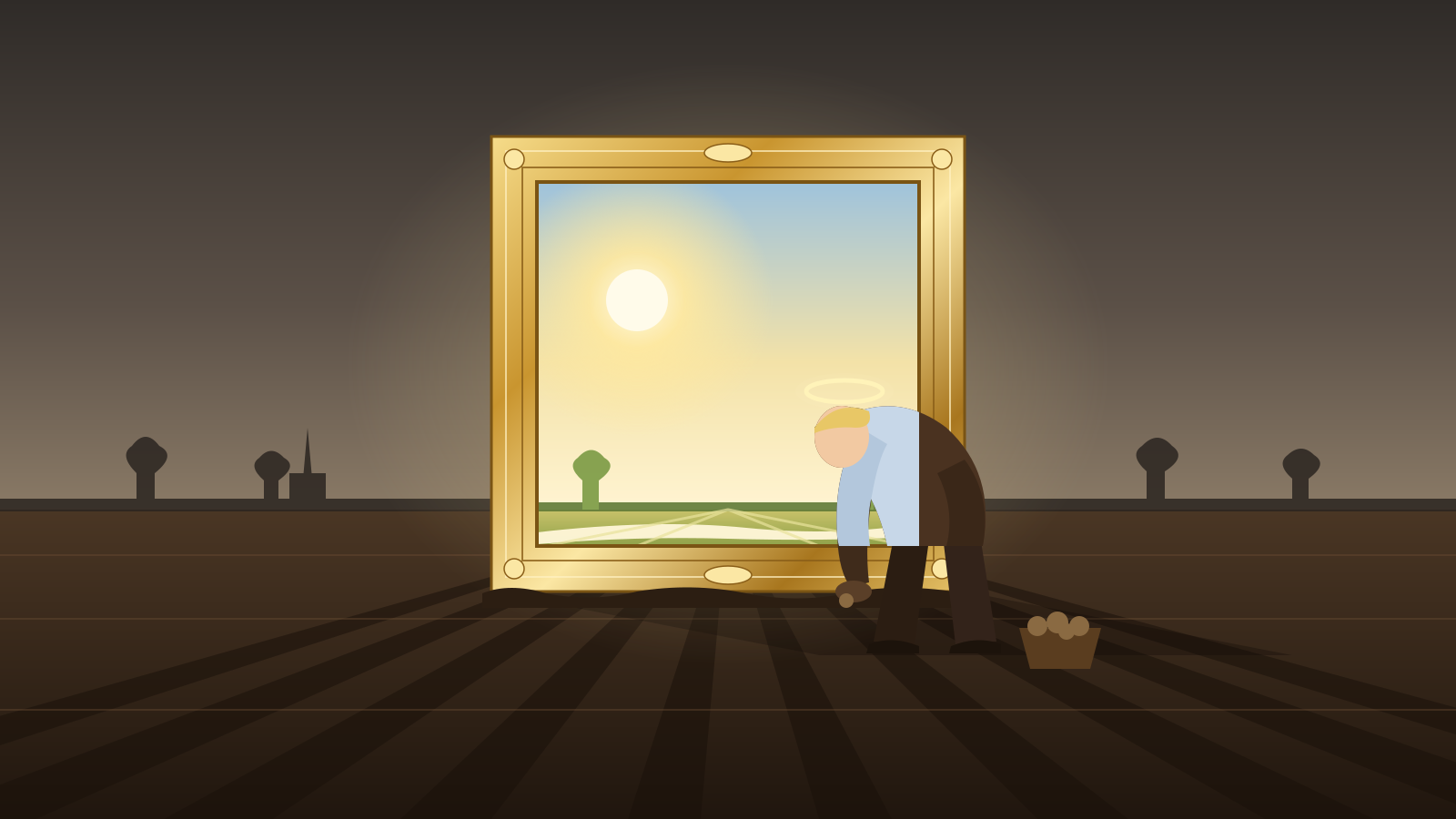
Constant Permeke (1886–1952) lived in Sint-Martens-Latem from 1909 to 1912 but did not find his style there: at the time he painted under the spell of Emile Claus's Luminism. His heavy, unvarnished depictions of farmers and fishermen emerged only after the First World War, in England, Ostend, and, from 1929, Jabbeke. Flemish Expressionism, the movement Permeke came to lead, is a 1920s Belgian art movement that painted rural life in dark earth tones and simplified, massive forms.
A young painter knocks on a colleague's door in Sint-Martens-Latem. He has come for something trivial: a few tubes of paint. It is 1909 or shortly after, and Constant Permeke is in his early twenties. Inside stands a large canvas. Men and women bend over a field, setting potatoes into the ground. No sun, no glittering river, no idyll. Only heavy bodies in dark, rough paint.
The painting is The Potato Planters, by Albert Servaes, an artist whose work people rarely took seriously in those years and sometimes simply laughed at. Permeke looks. He is so struck that he cannot get a word out. Whether it happened exactly like that, we cannot be sure. The story comes from a single witness, Georges Chabot. But it raises the question at the heart of this column: can you paint a village's light without making it prettier?
Sint-Martens-Latem around 1900: a village full of painters
The Latem School is the collective name for two groups of artists who settled around 1900 in Sint-Martens-Latem, a village on the river Lys (Leie) near Ghent. The first group arrived in 1899, the second in 1905. Why Latem of all places? According to art philosopher Willem Elias, the village clerk, Albijn Van den Abeele, a painter himself, could find artists cheap lodgings. Great ideals sometimes start with low rent.
The first group went to the countryside, looking for a pure, unspoiled world. George Minne sculpted inward-turned young men. Valerius De Saedeleer converted to Christianity in 1904 and painted religiously charged landscapes. Gustave Van de Woestyne spent several months in a monastery in 1905 and painted farmers with the stillness of saints. They meant it. These men were not looking for scenery in the farmer but for a conscience. Yet it remained an outsider's gaze: the farmer became a saint, not a person with an aching back.
Emile Claus and Luminism: light that makes everything prettier
Luminism is the Belgian variant of Impressionism, in which painters primarily capture the play of sunlight on landscapes and figures. Emile Claus, who lived a little further along the Lys in Astene, was its leading figure. When Constant Permeke arrived in Latem in 1909, he was still under Claus's spell. According to the catalogue of the Permeke Museum, he briefly saw Claus as the great renewer of Flemish painting. The young painters of the second Latem group, the brothers Gust and Léon De Smet and Frits Van den Berghe, were also painting in an Impressionist manner in those years.
Permeke never quite fit in. He lived with his fiancée, Marietje Delaere, before their marriage in 1912. Yet he often kept a stubborn distance from the boisterous antics of his friends. A free spirit, but not the life of the party. And Claus's light? It is beautiful, but it idealises in its own way. Where the first group made the farmer holy, Luminism made him sunny.
Albert Servaes and The Potato Planters (1909)
Albert Servaes (1883–1966) painted The Potato Planters (De Aardappelplanters) in 1909, a large, dark and rough canvas later acquired by the Royal Museums of Fine Arts of Belgium in Brussels. Art historians regard Servaes as the first true representative of Expressionism in Belgium. The extent of his influence on Permeke remains a matter of dispute. Critic Paul Fierens wrote that all Flemish Expressionists owed Servaes a debt, Permeke first among them. The Permeke Museum's own catalogue, by contrast, described the importance of Latem for Permeke as usually overstated. Biographer Roger Avermaete took a balanced view: Latem did little to enrich the work, but it did shape the mind.
Serves himself is a story of his own. He was a deeply devout man for whom painting was a form of prayer. In 1919 he drew a Way of the Cross so raw that, as Servaes later recalled, his spiritual guide, a Carmelite friar, could finally pray before one with his eyes open. Yet, on 30 May 1921, the Holy Office in Rome declared those Stations of the Cross unfit for public worship. The work had to leave the church. A believing artist showed suffering without embellishment, and his church pushed it out. It was not the doubter but the institution that could not bear the honesty of the image.
Permeke after 1914: war, England and Jabbeke
Constant Permeke found his own, unvarnished style only after the outbreak of the First World War. Called up in 1914, he was severely wounded and evacuated to England. In Chardstock, in the English county of Devon, he painted his first truly characteristic pictures in 1916–1917, according to Tate. After the war, he returned to Ostend and painted fishermen in browns and blacks, their bodies massive and distorted. From 1929 he lived in Jabbeke, between Ostend and Bruges, in his house, De Vier Winden (The Four Winds). There, farmers became his great subject.
Look at those farmers, and you see no saints and no sunny Sundays. Willem Elias describes how these Expressionists painted squat or emaciated, toiling bodies, unvarnished yet with deep respect. In Permeke, the light does not come from the sky. It sits in the earth itself, in ochres and browns laid thickly on the canvas. Here lies the answer to our question. Yes, you can paint a village without idealising it. But Permeke first had to leave the painters' village and go straight through a war.
The 'Flemish Expressionism' label: a new halo
Around 1920, the Brussels gallery and magazine Sélection, run by Paul-Gustave Van Hecke and André de Ridder, coined the term 'Flemish Expressionism'. They built the label around three names: Permeke, Gust De Smet and Frits Van den Berghe. Then the word "Flemish" became widely used. From 1926, critics increasingly stressed Flemish identity, the bond between people and soil, and the simple and the rustic.
Willem Elias points out that the adjective acquired meanings, such as national character, that had little to do with painting. The innovators of 1920 thus became the new academy.
That is the irony. Permeke had painted his way free of the pious farmer and the sunny farmer. Then others turned his farmer into the emblem of a people. From the standpoint of free inquiry, this episode is the heart of the story. Faith, beauty, and national pride are three different lenses, but they all do the same thing: they put an idea before the human being. Permeke's work shows that looking without such a lens is possible. Its reception shows how quickly someone else puts the lens back on.
From Latem to the 2024 farmers' protests in Brussels
The idyllic image of the Flemish countryside is still very much alive. Willem Elias notes that visitors to Latem today, guided by its tourist marketing, wrongly believe they are standing in the cradle of Flemish Expressionism. Meanwhile, on 1 February 2024, some 1,300 tractors rolled into the European Quarter of Brussels. Farmers were protesting against falling incomes and growing red tape. They were not scenery, saints, or sunshine: they were people whose accounts no longer added up.
This is a parallel, not an equation. But the question from that studio in 1909 has not gone away. Do we love the countryside, or our picture of it? And who gets to create that picture: us, or the people who live and work there?
Frequently asked questions
Did Constant Permeke romanticise the life of peasants?
He does not use it in his mature work. From the 1920s, Constant Permeke painted farmers and fishermen as heavy, unvarnished figures in dark earth tones, without religious or sunny embellishment. Critics later did use his work as an emblem of a Flemish national character. Reading that step as a new form of idealisation is an interpretation from this column's secular humanist perspective.
What is the Latem School?
The Latem School (School of Latem) is the collective name for two groups of artists in Sint-Martens-Latem on the river Lys in Belgium. The first group (from 1899), which included George Minne, Valerius De Saedeleer and Gustave Van de Woestyne, worked in a Symbolist, religiously inspired vein. The second group (from 1905), including the De Smet brothers, Frits Van den Berghe and Constant Permeke, began as Impressionists and turned Expressionist only after the First World War.
What is Luminism in Belgian painting?
Luminism is the Belgian variant of Impressionism, focusing on rendering sunlight on landscapes and figures. Emile Claus (1849–1924), who lived in Astene on the Lys, was its leading figure. Constant Permeke was still under his influence when he arrived in Sint-Martens-Latem in 1909.
Who was Albert Servaes?
Albert Servaes (1883–1966) was a Ghent-born painter of the Latem circle, regarded as Belgium's first true Expressionist. According to one witness, his painting The Potato Planters (1909) made a deep impression on Constant Permeke. On 30 May 1921, the Holy Office in Rome declared his 1919 Way of the Cross unfit for public worship.
Where did Constant Permeke live and work?
Constant Permeke lived in Sint-Martens-Latem from 1909 to 1912 and then in Ostend. During the First World War he stayed in England as a wounded soldier. From 1929 until his death in 1952, he lived in Jabbeke, Belgium, in the house De Vier Winden, now the Permeke Museum.
What is Flemish Expressionism?
Flemish Expressionism is a 1920s Belgian art movement that painted rural and fishing life in dark earth tones and simplified, massive forms. Around 1920, the Brussels gallery and magazine Sélection established the term, with Constant Permeke, Gust De Smet and Frits Van den Berghe involved.
Sources
- Elias, Willem. "Het expressionisme", in Aspecten van de Belgische kunst na '45, online at willemelias.be (2012).
- "Permeke en Servaes vóór 1914", Ons Erfdeel 30 (1987), via DBNL (with testimony from Georges Chabot and quotations from Paul Fierens, Roger Avermaete and the Permeke Museum catalogue).
- "Belangrijke data" and "Ten huize van… Albert Servaes", via DBNL (chronology and Albert Servaes's own account of the 1919 Way of the Cross).
- Alley, Ronald. Catalogue of the Tate Gallery's Collection of Modern Art, London, 1981, p. 585 (Constant Permeke biography).
- Permeke Museum, Jabbeke, press kit for the reopening (2024).
- VRT NWS and The Brussels Times, reporting on the Brussels farmers' protest, 1 February 2024.
- Values framework: deMens.nu and Humanistisch Verbond (free inquiry, self-determination).
Reactie plaatsen
Reacties