

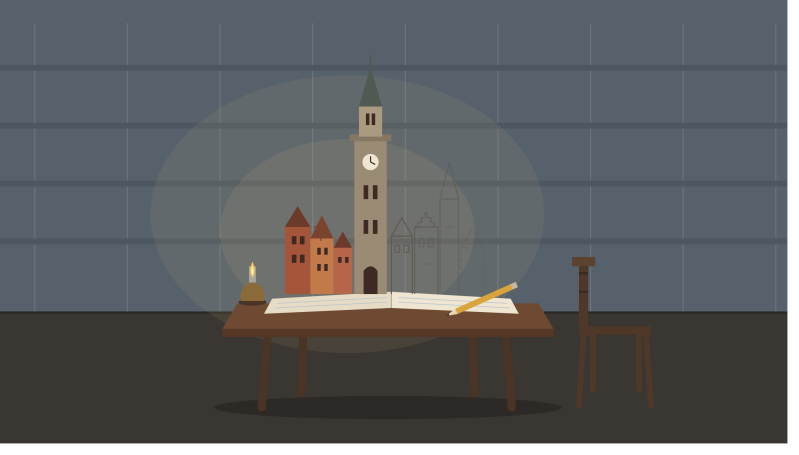
Henri Pirenne (1862–1935) was the Ghent historian whose seven-volume Histoire de Belgique (History of Belgium, 1900–1932) gave the country a coherent past reaching centuries before 1830. During the First World War, as a deportee without access to any archive, he wrote a history of Europe. His work shows that a historical story does not become 'true' through certainty but through method: source criticism, honesty about what you don't know, and a willingness to revise your own story.
A room in an inn in Creuzburg, a village on the Werra River in Thuringia. It is 31 January 1917. A fifty-four-year-old man opens a school exercise book. Next to him there is no archive, no library, and not a single charter: only a small textbook borrowed from the village school. The man is Henri Pirenne, Belgium's most famous historian. For twenty years he has built his country's past out of sources, charter by charter. Now he does something his profession distrusts: he writes history from memory. His subject is not Belgium but all of Europe, from the fall of Rome to the Renaissance.
Creuzburg, 1917: Henri Pirenne, the deported professor
Henri Pirenne was in Creuzburg because he refused to cooperate with German plans for Ghent University. The occupier wanted to reopen the French-speaking university in 1916 as a Dutch-speaking institution. Pirenne and his colleague Paul Fredericq would not take part. A Dutch-language university was an old and legitimate Flemish demand. However, this university was established during the German occupation as part of the Flamenpolitik, which aimed to turn the Flemish people against the Belgian state. For Pirenne and Fredericq, joining in was therefore collaboration, not emancipation. On 18 March 1916, both professors were arrested and deported to Germany. Pirenne passed through the camps of Krefeld and Holzminden and spent a few months in Jena. From January 1917 until the end of the war, he was confined to Creuzburg. An often-told anecdote sums up his attitude. When a German officer asked why he spoke French, even though he had studied in Leipzig and Berlin, Pirenne is said to have replied that he had forgotten German since 3 August 1914. Whether he said it in exactly those words cannot be established with certainty. It is certain that the war had a profound impact on him: his son Pierre was killed on the Yser front on 3 November 1914.
The Histoire de Belgique: a country with a past before 1830
The Histoire de Belgique is the seven-volume history of the Belgian provinces that Henri Pirenne published between 1900 and 1932. Its central claim is that these provinces have shared a common civilisation since the Middle Ages, at the crossroads of the Romance and Germanic worlds. For Pirenne, Belgium was therefore not an accidental invention of 1830 but the result of centuries of living together. What was new was his way of looking. Pirenne wrote not only about princes and battles but also about towns, trade, cloth-making and crafts. The French historian Marc Bloch later regarded it as a model of "total history." Across political divides, people in Belgium read and praised the work. The irony lies in the first volume. It appeared in 1899, first in German, as Geschichte Belgiens, at the urging of his Leipzig friend Karl Lamprecht. In October 1914 Lamprecht joined dozens of German scholars in signing the manifesto Aufruf an die Kulturwelt (Appeal to the Cultured World), which defended the invasion of Belgium.
Volume five: the manuscript Jenny Pirenne kept safe
Volume five of the Histoire de Belgique was finished on 11 November 1915, a few months before Henri Pirenne's deportation. While he was away, his wife Jenny Vanderhaeghen and friends had copies made and put somewhere safe. After the war, the volume was published, dedicated to Pierre. In the preface, Pirenne explains why he barely changed the text. He feared that making changes would expose him to the influence of events that occurred after the armistice. A man who had lost two years to exile and a son to the war refused to let his grief seep into his soul. That is not coldness. It is discipline.
Why Henri Pirenne stopped speaking of 'races' after 1918
The First World War led Henri Pirenne to rethink his method. After 1918, he abandoned the language of "races" and national character, which was common in European historical writing at the time. Instead, he became a champion of comparative history. That shift began in the exercise books of Creuzburg. Pirenne had seen scholars put their science at the service of a national cause. His Histoire de l'Europe (A History of Europe) attempts the opposite: no single country as hero, but Europe as a network of towns, trade and ideas.
He kept writing from 31 January 1917 to 7 August 1918. Then his wife and youngest son arrived in Creuzburg, and he put down his pen in the middle of the Renaissance. By the armistice, his story had reached about 1550. Later historians are less lyrical than his admirers. One recent reviewer calls the text very much a product of its time and points out that Pirenne never intended it for publication. That is precisely what makes it intriguing: it is a sketch that knows it is a sketch.
Henri Pirenne and the Flemish Movement: the blind spot of a national story
Pirenne's account of a shared Belgian civilisation drew sharp criticism, especially from Flanders. Critics, including the Dutch historian Pieter Geyl, accused him of projecting onto the past a unity that mainly served the Belgian state of his day. In their view, Pirenne also spread the image of a Flanders that had always been bilingual. That made the Frenchification of the Flemish elite look natural, rather than a question of power.
That criticism touches Pirenne's own life. He was a French-speaking Walloon from Verviers who taught in Ghent for 44 years. When Ghent University became fully Dutch-speaking in 1930, he retired and moved to Uccle, near Brussels. He died there on 24 October 1935. Here lies the character's contradiction. The man who wanted to tell Europe's story without one country as a hero struggled to see a story within his own country that led elsewhere than to Belgium. That does not make him a villain. It makes him human: like most of us, he saw most clearly what lay furthest from himself.
Free inquiry as the test: what makes a story about Belgium 'true'?
From the secular humanist principle of free inquiry, the answer to this column's question is clear. A historical story is as true as the method behind it and as honest as the limits it admits. Free inquiry (libre examen, vrij onderzoek) is the principle that no claim, whether religious, political or national, stands above critical examination. The fate of the exercise books makes the argument tangible. After Pirenne's death, his son Jacques edited the text, and the Histoire de l'Europe appeared in 1936. In 2014, the historians Jean-Pierre Devroey and Arnaud Knaepen returned to the original notebooks. They removed Jacques's changes, corrected factual errors and added more than sixty previously unpublished pages.
In other words, the story became truer because someone went back to the source. The same goes for the Histoire de Belgique. We see its strength (its attention to towns and the economy) and its weakness (the past as a run-up to 1830) precisely because later historians read Pirenne critically. This is an interpretation, not a neutral verdict. A nation that refuses to question its founding story treats history as dogma. Pirenne gave Belgium a story. Free inquiry gives Belgium the right to question it.
National stories in 2026: from canon to chatbot
Communities still look for a shared story today, and the question from Creuzburg has not gone away. In 2023, Flanders received an official canon of its history, while elsewhere in Europe people debated what belongs in the history classroom. This is a parallel, not an equation: every community tells itself a story, and the test is whether that story stays open to criticism. There is a second parallel. Language models now write fluent history from memory, without archives, much like Pirenne in his room at the inn. The difference lies in awareness. Pirenne knew his notebook was a sketch. A text that sounds just as confident does not always say so.
So the next time you read a story about Belgium, including this one, ask yourself the question Pirenne asked himself. Where does this information come from? And what don't we know?
Frequently asked questions
What makes a historical account true when sources are missing?
A historical account without sources is at best a sketch, and it only becomes reliable when it honestly names that limitation. In 1917–1918 Henri Pirenne wrote a history of Europe in Creuzburg with nothing but a school textbook and did not intend it for publication. From the principle of free inquiry, a story becomes 'true' through method, transparency and a willingness to revise, not through confidence.
Why was Henri Pirenne imprisoned in Germany during World War I?
Henri Pirenne was arrested with Paul Fredericq on 18 March 1916 and deported to Germany because both refused to cooperate with the reopening of Ghent University as a Dutch-speaking institution under German occupation. He was held in Krefeld, Holzminden and Jena, and from January 1917 until the end of the war in Creuzburg, Thuringia.
What is Henri Pirenne's History of Belgium?
Henri Pirenne's Histoire de Belgique (History of Belgium) is a seven-volume history of the Belgian provinces, published between 1900 and 1932. In it, Pirenne argues that these provinces have shared a common civilisation since the Middle Ages. The first volume appeared in German in 1899, before the French original.
How did World War I change Henri Pirenne's thinking?
After World War I, Henri Pirenne abandoned the idea of 'races' and national character and became an advocate of comparative history. The shift is already visible in his Histoire de l'Europe, written in captivity and published posthumously in 1936.
Why was Henri Pirenne criticised in Flanders?
Flemish critics and the Dutch historian Pieter Geyl accused Henri Pirenne of projecting a Belgian unity onto the past that mainly served the Belgian state of his time. They also pointed to his image of an always bilingual Flanders, which made the Frenchification of the elite look natural. Reading this criticism as exposing a blind spot is an interpretation based on the principle of free inquiry.
Sources
- Pirenne, H., Histoire de Belgique, 7 vols., Brussels, 1900–1932 (volume five with preface and dedication to Pierre Pirenne; Dutch translation Geschiedenis van België available via dbnl.org).
- Pirenne, H., Histoire de l'Europe éditée d'après les carnets de captivité (1916–1918), suivie des Souvenirs de captivité, ed. J.-P. Devroey and A. Knaepen, Brussels, Académie royale de Belgique, 2014.
- Laqua, D., review of the above edition, English Historical Review 132 (2017).
- Warland, G., 'Pirenne, Henri', in 1914-1918-online. International Encyclopedia of the First World War.
- Keymeulen, S. and Tollebeek, J., Henri Pirenne, Historian: A Life in Pictures, Leuven, 2011; reviewed in Journal of Belgian History, 2012.
- Van Campenhout, 'Werk van historicus Henri Pirenne', Ons Erfdeel / De Lage Landen, 2012.
- Ganshof, F.-L. et al., obituary of Henri Pirenne, Ghent University Memorialis; entry 'Pirenne, Henri' in the Nieuwe Encyclopedie van de Vlaamse Beweging.
- Values framework: demens.nu and humanistischverbond.be (principle of free inquiry).
Reactie plaatsen
Reacties