

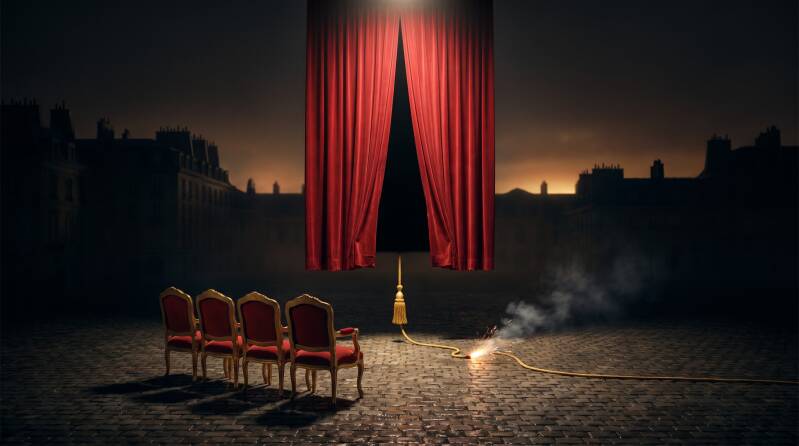
La Muette de Portici is an 1828 opera by the French composer Daniel Auber about a popular uprising in Naples. After a performance at the Théâtre de la Monnaie in Brussels on 25 August 1830, the audience poured into the streets and started the riots that led to Belgian independence. Yet the opera did not set off that revolution by accident: the anger was already there, and the date had been announced in advance.
Two men stand on a painted beach near Naples. One is the fisherman Masaniello, the other his friend Pietro. They sing about sacred love for the fatherland. In the Brussels opera house, nobody can sit still any longer. It is Wednesday, 25 August 1830. The tenor Jean-François Lafeuillade is singing Masaniello. According to a later account, the cheering is so loud that the singers have to start the duet again. The boxes hold the well-to-do middle class; the standing room holds ordinary people. Outside, on the Place de la Monnaie, a crowd without tickets is waiting. Soldiers are stationed in their barracks, while a few guards monitor the hall. The opera is not over yet. Still, the hall empties into the street and into history.
La Muette de Portici and the Belgian Revolution of 1830
La Muette de Portici (‘The Mute Girl of Portici’) is a grand opera by Daniel Auber, first performed in Paris in 1828. Its Brussels performance on 25 August 1830 is remembered as the spark of the Belgian Revolution: the uprising through which the southern provinces broke away from King William I’s United Kingdom of the Netherlands. The opera is set in Naples in 1647. Masaniello leads a popular revolt against Spanish rule after the viceroy’s son seduces and abandons his mute sister, Fenella. Fenella never sings a note; instead, a dancer portrays her character through gesture. That was new, as were the crowd scenes, the huge chorus, and a Vesuvius erupting on stage.
Brussels already knew the piece. William had attended its Brussels premiere himself in 1829. But after the Paris July Revolution of late July 1830, audiences began shouting against Dutch rule during performances. According to the musicologist Sonia Slatin, the opera was then temporarily banned, while other sources speak only of a ban being considered. Either way, La Muette was cleared for 25 August.
Brussels, August 1830: a city full of fuel
The riot of 25 August 1830 was not an isolated event. Brussels was full of political grievances, and the uprising had even been announced in advance. The South held more than sixty per cent of the population, yet it had the same number of seats in the States General as the North. People complained about language policy, about trials of critical journalists, and about the justice minister, Cornelis van Maanen. Meanwhile, Catholics and liberals, once opponents, joined forces against the king. Historians call this alliance unionism.
William, I was no fairy-tale tyrant. He saw himself as an enlightened monarch: he founded universities in Ghent and Liège and invested in canals and industry. That is precisely why he could not understand the grumbling in the south. His tragedy was that of many reformers: he forgot to ask whether people wanted to be reformed his way. In late August, Brussels celebrated the king’s birthday and his fifteen years on the throne. Meanwhile, a mocking programme appeared on walls and in leaflets: Monday, 23 August, fireworks; Tuesday, 24 August, the king’s birthday; Wednesday, 25 August, revolution. The authorities cancelled part of the festivities. The opera stayed on the bill.
Jean-François Lafeuillade and the cry ‘Aux armes!’
We do not know for certain what happened inside the hall. The best-known version centres on the tenor Jean-François Lafeuillade and the duet "Amour sacré de la patrie." In 1830 that duet sounded like a pamphlet. Masaniello sings, 'À mon pays je dois la vie, il me devra la liberté’ (to my country I owe my life; it will owe me its freedom). According to the account published by the theatre historian Lionel Renieu in 1928, the hall erupted when Lafeuillade cried ‘Aux armes!’ (‘To arms!’).
Versions differ on whether Lafeuillade improvised that cry. Direct eyewitness accounts are scarce. The timing, moreover, was no accident. According to Slatin, the opposition paper Courrier des Pays-Bas had urged readers, in coded terms, to leave before the fifth act. Lafeuillade is the most intriguing character because he is so difficult to read. He was a French singer who staged a revolt every night. The day after the riot, he joined the civic guard set up to restore order. And on 12 September, according to the historian Tom Verschaffel, he sang the Brabançonne in the same theatre: the new battle song that would later become the national anthem. Was Lafeuillade a committed patriot, an actor who took his role too seriously, or a professional singing what he was asked to sing? The sources are silent. His contradiction is that of 1830 itself: between performance and conviction, between revolt and order.
The night of 25 August 1830: from opera to riot
After the performance of La Muette, groups marched through Brussels. They attacked the house of the minister Van Maanen and the offices of Le National, the pro-government newspaper of Giorgio Libri-Bagnano. It became a night of rioting and looting. They emptied food shops and gun shops alike, while the army hesitated. The Brussels middle class was alarmed. It wanted reform, not chaos. So the next day it set up a civic guard under Baron Emmanuel van der Linden d’Hoogvorst to disarm the rioters. Yet that very civic guard became the centre of resistance to William I. After the fighting in Brussels Park from 23 to 26 September, the Provisional Government, the rebels’ temporary administration, proclaimed independence on 4 October 1830.
Act five of La Muette: the ending nobody saw
The audience of 25 August 1830 never saw the end of La Muette de Portici. In that ending, the revolt goes badly wrong. Masaniello refuses to shed innocent blood. hist, his own comrades poison him. Half insane, he dies in battle, Fenella throws herself into Vesuvius, and the nobles retake Naples. Brussels had seen the piece before. Yet that night, the hall booed the fifth act off the stage. It took what it needed from the opera—a song and a battle cry—and left the warning behind. That may be the most honest lesson of the evening. Art does not send a single message. An audience chooses what it hears.
Free inquiry and the myth of 1830
Seen through the principle of free inquiry, the answer to our question is clear: no, art did not start this revolution by accident. La Muette de Portici gave existing anger a room, a date and a song. Who organised the riot remains an open question. Historians disagree. Rumours persisted that middle-class opponents stirred up and even paid people in taverns, but there was no evidence of an organised coup. Nobody ever claimed responsibility.
The myth of the revolutionary opera suited the young Belgium well. A nation born from an aria sounds nobler than a nation born from looting. In 1835 Gustaf Wappers, commissioned by the new government, painted his ‘Episode of the September Days 1830'. This painting also served as a form of art that conveyed a narrative. Critical thinking also means asking who gained from 1830. The Constitution of 1831 was one of the most liberal in Europe. It guaranteed freedom of the press, of worship, of education, and of association and banned censorship for the benefit of society Yet only about one per cent of the population could vote: men who paid enough tax. In other words, the people who stormed into the streets on 25 August got no votes themselves. Their anger helped write a constitution that shut them out. The secular humanist ideal of equality represents the shadow side of an otherwise admirable charter of freedom.
From La Monnaie to 2030: art, protest, and freedom
La Monnaie in Brussels still stands, although the building was largely rebuilt after a fire in 1855. Only the portico and some outer walls date back to 1830. The parallel with today is obvious, but it is a parallel, not an equation. Protesters around the world still use songs, images and theatre. Regimes that ban plays or songs do so for the same reason as the 1830 authorities: they fear what crowds will do with them. The lesson of 1830 is twofold. Censorship does not stop anger that already exists. But those who use art only as a battle cry no longer hear the fifth act.
In 2030, Belgium turns two hundred. Which song would captivate an audience today? And would we remain seated until the end?
Frequently asked questions
Did an opera start the Belgian Revolution?
No, not on its own. The performance of La Muette de Portici at La Monnaie in Brussels on 25 August 1830 was the spark, not the cause. Political grievances against King William I already existed, and leaflets had announced a "revolution" for 25 August in advance. Viewed through free inquiry, ‘the opera that made a nation’ is, above all, a convenient founding myth.
What is La Muette de Portici about?
La Muette de Portici is an opera by the French composer Daniel Auber, with a libretto by Germain Delavigne and Eugène Scribe, first performed in Paris in 1828. It tells the story of the Neapolitan fisherman Masaniello and his revolt against Spanish rule in 1647. A dancer plays the title role of Masaniello's mute sister, Fenella.
What caused the Belgian Revolution of 1830?
The Belgian Revolution grew out of accumulated grievances in the southern provinces of the United Kingdom of the Netherlands. The South was under-represented in the States General, there was anger over language policy and press trials, and Catholics and liberals united against King William I. The July Revolution in Paris in 1830 served as the decisive catalyst.
Who was Jean-François Lafeuillade?
Jean-François Lafeuillade was the French tenor who sang Masaniello at La Monnaie in Brussels on 25 August 1830. In the best-known version, he cried ‘Aux armes!’ during the duet ‘Amour sacré de la patrie', although it is uncertain whether he improvised it. After the riot he joined the civic guard, and on 12 September 1830 he sang the Brabançonne at La Monnaie.
What happened in Brussels on 25 August 1830?
On 25 August 1830, the opera audience poured out of La Monnaie and marched through Brussels with a waiting crowd. Rioters assaulted the house of Justice Minister Van Maanen, targeted the offices of the pro-government newspaper Le National, and looted shops. The next day the middle class set up a civic guard, which later led the resistance against William I.
How does La Muette de Portici end?
La Muette de Portici ends in tragedy. Masaniello is poisoned by his comrades and dies in battle, his sister Fenella leaps into Vesuvius, and the nobles retake Naples. The Brussels audience of 25 August 1830 booed the fifth act and never saw that ending.
Sources
- Slatin, Sonia. “Opera and Revolution: La Muette de Portici and the Belgian Revolution of 1830 Revisited.” Journal of Musicological Research 3, nr. 3 (1979) : 45–62.
- Renieu, Lionel. Histoire des théâtres de Bruxelles depuis leur origine jusqu’à ce jour. Paris/Bruxelles : Duchartre & Van Buggenhoudt, 1928, pp. 744–745.
- Mallinson, Vernon. Belgium. New York : Praeger, 1970.
- Verschaffel, Tom. Artikel over de Brabançonne en De Vlaamse Leeuw. Volkskundig Bulletin 24 (1998).
- Vandervelden, Jos. Het verhaal van België. Kalmthout : Pelckmans ; fragment « De opera die België in lichterlaaie zette », VRT NWS, 25 augustus 2025.
- “Le roi règne mais ne gouverne plus.” La Libre Belgique, 5 September 2005.
- Auber, Daniel-François-Esprit. La Muette de Portici, partition. Paris : E. Troupenas, 1828 (Gallica, Bibliothèque nationale de France).
- Grondwet van België / Constitution belge, 7 februari 1831.
- Waardenkader : deMens.nu en Humanistisch Verbond (humanistischverbond.be).
Reactie plaatsen
Reacties