

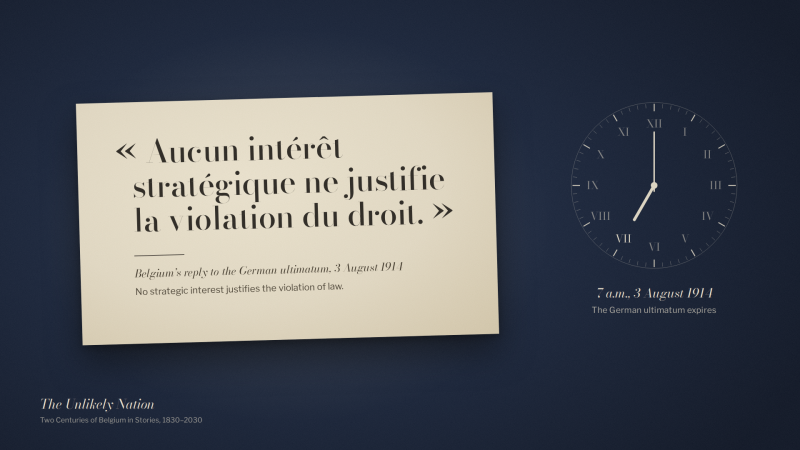
The German ultimatum to Belgium was a demand issued on 2 August 1914 with a twelve-hour deadline: let the German army march through to France, or be treated as an enemy. King Albert I and his government refused during the night of 2–3 August, and on 4 August Germany invaded. That ‘no’ cost Belgium thousands of civilian lives, a million refugees and four years of occupation and made a small neutral country a symbol of law against power.
Brussels, Sunday evening, 2 August 1914. In the King’s study at the Royal Palace, cabinet ministers, senior statesmen and four generals sit around one table. Foreign Minister Julien Davignon reads aloud a German note, hastily translated a few hours earlier. According to those present, a long silence follows.
The note is polite in tone. Germany claims to have ‘reliable information’ that France intends to advance on the Meuse via Givet and Namur. Berlin therefore asks for free passage, offering compensation and a promise of Belgian independence after the war. Resistance will make Belgium an enemy, and Germany wants an answer by 7 a.m.
At the head of the table sits Albert I, aged 39. Later accounts by those present agree on one thing: the refusal was never in doubt. The ‘no’ took less than a minute to deliver. The sentences that followed took all night.
What did Germany’s ultimatum to Belgium demand in August 1914?
Germany’s ultimatum of 2 August 1914 demanded that Belgium let the German army march freely through to France. The demand violated Belgian neutrality, which Prussia and other countries had guaranteed internationally since 1839.
The supposed French advance through Namur was a pretext. Germany’s war plan, known as the Schlieffen Plan, had long relied on a rapid sweep through Belgium to outflank France from the north. The ultimatum itself was drafted in Berlin on 26 July and sent to the German envoy in Brussels on 29 July.
What was Belgian neutrality under the 1839 Treaty of London?
Belgian neutrality was an obligation imposed on Belgium by the great powers in the Treaty of London of 1839. Belgium had to remain ‘perpetually neutral’ under the treaty. In return, Britain, France, Prussia, Austria and Russia promised to protect it.
Belgium had not chosen neutrality for itself: it was the price of the country’s existence. In August 1914, one of the guarantors was asking Belgium to tear that price up.
Why did King Albert I refuse to let the German army through?
King Albert I and Prime Minister Charles de Broqueville’s government refused because free passage would break Belgium’s neutrality and leave the country at the mercy of the strongest. Belgium’s reply puts it in one sentence: « Aucun intérêt stratégique ne justifie la violation du droit. » No strategic interest justifies the violation of law.
That sentence did not come easily. Everyone at the table had their own wording, and the meeting stalled. A small group therefore went to the Foreign Ministry on the Rue de la Loi. There, Baron de Gaiffier d’Hestroy, the ministry’s senior political official, already had a draft that needed only minor changes.
The reply reached German envoy Claus von Below-Saleske at 7 a.m. on 3 August. The government expressed « un profond et douloureux étonnement », a deep and painful astonishment. Giving in, it said, would sacrifice « l’honneur de la nation », the honour of the nation.
Why was Albert I an unlikely opponent of Germany?
On paper, Albert I was the last man you would expect to say 'no' to. He came from the German princely house of Saxe-Coburg and Gotha and was married to Elisabeth, Duchess of Bavaria. He was even honorary colonel of a German dragoon regiment in Lüneburg.
Albert was no warlord either. He became heir only after his elder brother, Baudouin, died young in 1891, and he was known as a quiet, thoughtful reader. Yet he knew what might come. In November 1913, he visited Kaiser Wilhelm II at Potsdam, where, according to the Belgian envoy Baron Eugène Beyens, the Kaiser called war with France ‘inevitable and close at hand’.
That is the human contradiction at the heart of this king. His family, his wife and his titles pointed to Berlin. His constitutional oath pointed to Brussels. He chose the oath.
What did Belgium’s refusal cost in 1914–1918?
Belgium’s refusal cost thousands of civilian lives, a million refugees and four years of occupation. On the morning of Tuesday 4 August, German troops crossed the border at Gemmenich. That same morning, Albert I addressed Parliament: « Un pays qui se défend s’impose au respect de tous : ce pays ne périt pas ! » A country that defends itself commands everyone’s respect; such a country does not perish.
You, the reader, know what the men around the table that night did not. Between August and October 1914, according to historians John Horne and Alan Kramer, the German army executed 5,521 Belgian civilians. In Dinant, on 23 August, the German army killed 674 men, women and children. Two days later, the university library of Leuven (Louvain) went up in flames.
Around a million Belgians fled to the Netherlands. In late 1916, 58,432 Belgians were deported to Germany as forced labour, and another 62,155 were made to work behind the front lines. The country stayed occupied for four years, apart from a narrow strip behind the River Yser.
Why did German soldiers kill Belgian civilians in 1914?
German soldiers killed Belgian civilians because many believed civilians were shooting at them. Horne and Kramer show that this fear of ‘francs-tireurs’, armed civilians, was largely a collective delusion. Nervous troops saw snipers everywhere, and their officers answered that fear with collective punishment. That explains the violence; it justifies none of it.
Could Belgium have given in, like Luxembourg?
Yes, Belgium could have given in, as Luxembourg did. The Grand Duchy was occupied on 2 August and put up no armed resistance. A pro-German pamphlet from 1915, Alexander Fuehr’s The Neutrality of Belgium, argued that Belgium would have acted wisely by yielding to superior force and demanding compensation. That is not a straw man: it is the logic of someone who wants to spare lives.
Belgium’s ‘no’ did change the course of the war. Britain declared war on Germany on 4 August, with the violation of Belgian neutrality as its main public reason. That evening, according to the British ambassador, Bethmann Hollweg called the 1839 treaty a ‘scrap of paper’. Some historians, including Alexander Watson, believe Britain would have joined anyway but later and less united.
What does Belgium’s 1914 ‘no’ mean from a secular humanist perspective?
From a secular humanist perspective, Belgium’s 1914 ‘no’ is a choice for the rule of law over the rule of the strongest, but it is not a choice without shadows. The contrast is sharpest in what German Chancellor Theobald von Bethmann Hollweg told the Reichstag on 4 August: « Not kennt kein Gebot! » Necessity knows no law.
Bethmann Hollweg was no cartoon villain. In the same speech he openly admitted that the invasion contradicted « den Geboten des Völkerrechts », the rules of international law. He promised to make up for the wrong later. That is what makes his phrase so dangerous: whoever says necessity knows no law turns every rule into a temporary favour.
Belgium’s reply set something against it. A neutrality imposed from outside in 1839 became Belgium’s own choice in 1914. That is self-determination in a pure form: a country decides for itself that a rule still applies when it hurts.
Yet critical thinking calls for two honest caveats. A small circle of men took the decision that night, in a country where women could not vote and wealthier men had extra votes. The people of Dinant paid a price, but no one ever asked them about it. Moreover, the reply praised Belgium’s role « dans la civilisation du monde », while that same Belgium had ruled the Congo as a colony since 1908 without the consent of the Congolese.
The right Belgium claimed for itself, it denied to others. That does not make the ‘no’ of 1914 any less just. It shows that a principle is complete only when it applies to those not at the table.
What does it cost today to say ‘no’ to a powerful neighbour?
The question of 1914 has not gone away: small states next to big neighbours still choose between going along and holding out. The most obvious parallel is Ukraine in 2022. It is a parallel, not an equation: a different time, different actors, a different war.
The core remains the same. Whoever says ‘no’ to power rarely chooses only for themselves; others pay too.
The humanist question is therefore not only whether to say ‘no’, but also who gets a say and who pays the bill. In 1914, that second group was not at the table. Who is missing from the table today?
Frequently asked questions
Why did Germany invade Belgium in 1914?
Germany invaded Belgium on 4 August 1914 because its war plan, the Schlieffen Plan, required a rapid advance through Belgium into northern France. The official pretext was an alleged French advance through Namur. Belgium had refused to let the German army pass on 3 August.
What was the German ultimatum to Belgium in 1914?
The German ultimatum of 2 August 1914 demanded free passage for the German army through Belgium to France, with a twelve-hour deadline. In return, Germany promised compensation and Belgian independence after the war. If Belgium resisted, Germany would treat it as an enemy.
How did Belgium respond to the German ultimatum?
Belgium rejected the German ultimatum at 7 a.m. on 3 August 1914. Its reply stated that no strategic interest justifies the violation of the law and that accepting it would sacrifice the nation’s honour. The government announced it would repel any attack using all available means.
What did King Albert I say on 4 August 1914?
King Albert I addressed the Belgian Parliament on 4 August 1914, the morning of the German invasion. He called for national unity and ended with: « Un pays qui se défend s’impose au respect de tous : ce pays ne périt pas ! » In English: a country that defends itself commands everyone’s respect and does not perish.
How many Belgian civilians did the German army kill in 1914?
According to historians John Horne and Alan Kramer, the German army executed 5,521 Belgian civilians between August and October 1914. The worst massacre occurred in Dinant, where the German army killed 674 people on 23 August. Allied propaganda labelled these events the ‘Rape of Belgium’, and archives from five countries document the killings themselves.
Was Belgium neutral in World War I?
Yes, Belgium was bound to neutrality at the start of World War I under the 1839 Treaty of London. Germany violated that neutrality by invading on 4 August 1914. From then on, Belgium defended itself and fought alongside France and Britain.
Sources
- Primary sources: German ultimatum to Belgium and Belgian reply, 2 and 3 August 1914 (Belgian Grey Book; text via commemorer14-18.be, Fédération Wallonie-Bruxelles) · Speech by Albert I to the Joint Chambers, 4 August 1914 · Speech by Th. von Bethmann Hollweg to the Reichstag, 4 August 1914 (stenographic record) · A. de Bassompierre, ‘La nuit du 2 au 3 août 1914 au ministère des Affaires étrangères de Belgique’ (1916) · Baron E. Beyens, Germany Before the War (1916) · Treaty of London, 19 April 1839.
- Secondary sources: J. Horne & A. Kramer, German Atrocities, 1914: A History of Denial (Yale University Press, 2001) · J. Horne, ‘Atrocities’, 1914-1918-online. International Encyclopedia of the First World War · S. De Schaepdrijver, De Groote Oorlog. Het koninkrijk België tijdens de Eerste Wereldoorlog (Atlas, 1997) · A. Watson, Ring of Steel (Allen Lane, 2014) · A. Fuehr, The Neutrality of Belgium (1915).
- Values framework: deMens.nu and humanistischverbond.be (free inquiry, self-determination, equality, and critical thinking).
Reactie plaatsen
Reacties