

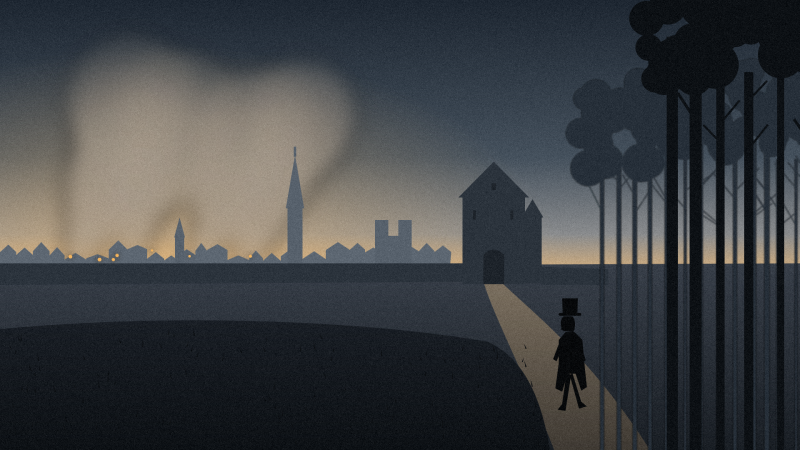
23 September 1830, at dawn: Charles Rogier leaves Brussels as the fighting begins.
The Belgian Revolution of 1830 established a lasting state because its leaders turned street improvisation into regulations within months: an elected National Congress and the Constitution of 7 February 1831. September Days: The street fights of 23 to 26 September 1830, when Brussels insurgents and volunteers drove the Dutch troops from the city. One of the men who then gave the revolt a government, the Liège lawyer Charles Rogier, had himself escaped on the first morning of the conflict.
It is first light on 23 September 1830. Charles Rogier leaves Brussels through the Porte de Hal. On the other side of the city, at the Porte de Schaerbeek, the first shots ring out. Prince Frederick's Dutch army is on the offensive.
Rogier is 30 years old. Two weeks ago he had entered the capital at the head of the volunteers from Liège. He walks off now. According to the earliest historical records, he is said to have wandered into the Sonian Forest, although not far. Near enough to hear the shots.
We know what Rogier doesn't know that morning. The country he fought for will still exist nearly two hundred years later. He knows only that the metropolis behind him has no leaders, no plan, and no government.
In 1830, Charles Rogier led the Liège volunteers.
A young lawyer from Liège, Charles Rogier (1800–1885) led volunteers to Brussels in September 1830 and eventually became one of the founders of the Belgian state. He was not born a Belgian. Rogier was born at Saint-Quentin (France); his father, an officer, died in 1812 in the Russian war of Napoleon. Then the family relocated into Liège.
Late in August 1830, news arrives in Liège that riots have broken out in Brussels following a performance of the opera La Muette de Portici. Rogier is seeking volunteers. On 4 September he leaves with a column for Brussels, arriving in the city on 7 September. It is not known how many men he brought with him; estimates range from a little over a hundred to five hundred.
That is precisely why his travel on 23 September seems so personal. Charles Rogier was not a coward. The historian Robert Demoulin termed him by far the bravest of the leaders, since he was among the last to go, and only when all hope was lost. In one man lived courage and mistrust.
Why did the Belgian Revolution leaders leave Brussels in September 1830?
The leaders of the insurrection left Brussels because they believed the city could not resist an organised army. Prince Frederick was advancing with about 10,000 to 14,000 men and artillery. Aléandré Gèndébié and Silvaine Van de Weyer had already retreated to Valéens in France. Félix de Mérode had taken sanctuary at his mother's château in Rixensart.
An eyewitness, Renard, later detailed the night before the attack: He estimated that there were about forty armed men on watch and at most three hundred prepared to resist. There were, he noted, 'no leaders, no authority, no plan, no direction'.
But Brussels remained. The early defenders were largely inhabitants of the poorest neighbourhoods, as well as farmers from adjacent villages and volunteers from Hainaut and Liège. They created barricades and held them without orders from above.
At Brussels, in the September Days of 1830, there was a revolution.
During the September Days (23-26 September 1830), the Dutch army was kept locked up in the Brussels Park by armed citizens and volunteers, who forced it to withdraw. Troops of Prince Frederick retired on the night of 26–27 September. The insurrection had been victorious. And without a leader.
Charles Rogier was back again on the night of 23–24 September as soon as he learned that the defence was holding. On 24 September he created an Administrative Commission comprising Baron Emmanuel van der Linden d'Hooghvorst and former technical officer André Jolly. Their initial proclamation is remarkably frank. For two days, they wrote, there had been no constituted authority in Brussels, and the energy of the people had filled the space.
It was expensive. Belgian losses are placed at four or five hundred dead and perhaps a thousand injured. Sources differ dramatically on the Dutch casualties.
How did Belgium’s Provisional Government make do with a new country in 1830?
On 25 and 26 September, the Administrative Commission became the Provisional Government of Belgium, with Charles Rogier as one of its moving spirits. We had to build everything from the ground up. Frans van Kalken, historian, writes that when a Central Committee took over the daily running of government on 28 September, there were only 10.36 guilders left in the treasury.
On 4 October 1830, the Provisional Government proclaimed the independence of the Belgian provinces. A National Congress would be chosen to draft a constitution. This event is the decisive moment in the story. The men who had not run the street resolved that neither the street nor they themselves would have the last word. That word would become written rules.
1830 Belgian Revolution – how did it become a lasting state?
The Belgian Revolution created a durable state, since its improvisation was anchored into institutions. On 3 November 1830, a National Congress of 200 members was elected. The Constitution was enacted on 7 February 1831 and on 21 July 1831. Leopold I took the oath as the first King of the Belgians.
This constitution was one of the most liberal in Europe. It guaranteed freedom of worship, of speech, of the press, of education, and of assembly. It said no one may be made to take part in the rituals of any faith.
Charles Rogier had little patience with anyone who referred to the revolution as a Catholic undertaking. In a letter to the French MP François Mauguin, he criticised the so-called idea of a “sacristy revolution.” He said the administration was dominated by young liberals who did not go to church, with Félix de Mérode and one other as the only exceptions.
What did Belgium's 1831 Constitution mean for the separation of church and state?
The 1831 Constitution liberated the church from the state, but not the state from the church completely. Article 16 prevented the state from meddling with the appointment of clergy. It demanded in the same clause a civil marriage before any religious blessing. But Article 117 required the state to cover the salaries of ministers of religion, a concession which the Catholic Church had demanded.
The result is a mixed conclusion, viewed through the lens of the secular humanism ethic of unfettered inquiry. For the first time, the constitution placed the citizen's conscience above any religious or royal truth. Separation of church and state was a compromise, not a principle. That compromise would keep Belgium busy for a long time, from the School War until the present.
The greatest contradiction is elsewhere. The September defenders were generally of the lower classes. The National Congress was, however, elected by 46,099 persons who paid enough tax or held a degree or office – one in every hundred citizens.
Thus, the men on the barricade had no vote. Universal male suffrage with weighted plural votes was not introduced until 1893, and women did not vote in a parliamentary election until 1949. That is not a footnote to the idea of equality. The freedom of 1830 was real, but it was initially freedom for the few.
What can Belgium learn from 1830 today?
The year 1830 demonstrates that a nation is not founded on a single heroic act but on the willingness to transform improvisation into agreed laws that safeguard even those who disagree. Charles Rogier was later twice prime minister, between 1847 and 1852 and 1857 and 1868. The man who entered Sonian Forest became the founder of the state.
Look at Belgium now, and you see a country that still runs on compromise: between language communities, between worldviews, and between regions. That's a parallel. Not an equation. In 1830 the stakes were a war; today they are governmental reforms and coalition agreements. But the topic is connected. Does a state keep together as long as its norms are stronger than the doubts of people who make them?
Rogier had his doubts on 23 September but returned nevertheless. Maybe that’s the most honest origin narrative a country can have: not the hero who never hesitated, but the one who hesitated and took responsibility anyway. Belgium will be two hundred years old in 2030. It deserves a story that doesn't gloss over that doubt."
Frequently asked questions
Who was Charles Rogier?
Charles Rogier (1800–1885) was a Belgian liberal politician and one of the leaders of the Belgian Revolution of 1830. In September 1830 he led volunteers from Liège to Brussels, then sat on the Administrative Commission and the Provisional Government. He later served twice as prime minister, from 1847 to 1852 and from 1857 to 1868.
What were the September Days of 1830?
The September Days were the street battles in Brussels from 23 to 26 September 1830 between insurgents and the Dutch army of Prince Frederick. The Dutch troops withdrew on the night of 26–27 September. That victory opened the way to Belgian independence.
When did Belgium become independent?
Belgium's provisional government declared independence on 4 October 1830. The National Congress confirmed independence on 18 November 1830. The Netherlands recognised Belgium only in 1839.
Was Belgium's 1831 Constitution liberal?
Yes, Belgium's Constitution of 7 February 1831 was regarded as one of the most liberal constitutions of its time. It guaranteed freedom of worship, expression, the press, education and association, among others. The right to vote, however, remained limited to about one per cent of the population.
Why did Charles Rogier flee Brussels on 23 September 1830?
Charles Rogier left Brussels because, like most revolutionary leaders, he believed resistance to the Dutch army was futile. When he heard that the defence was holding, he returned on the night of 23–24 September. His departure is described by the historians Frans van Kalken (1910) and Robert Demoulin (1934); what he did in the Sonian Forest is not recorded in detail.
Sources
Primary source
-
Belgian Constitution of 7 February 1831, Articles 14-17 and 117 (text quoted in the parliamentary records of the Belgian Chamber, dekamer.be).
-
Déclaration de la Commission administrative, Bruxelles, 24 septembre 1830.
-
Renard's eye-witness account of the night of 22-23 September 1830 and Charles Rogier's letter to François Mauguin, both quoted in Ernest Discailles, Charles Rogier (1800-1885) d'après des documents inédits, Brussels, 1892-1895.
Second-hand sources
-
Robert Demoulin, Les Journées de septembre 1830 à Bruxelles et en province, Liège, 1934 (online at be1830.and Presses universitaires de Liège).
-
Frans van Kalken, Histoire du royaume des Pays-Bas and de la révolution belge de 1830, Bruxelles, 1910, ch. IX (online at unionisme.be).
-
Louis de Lichtervelde, Het Nationaal Congres. L'oeuvre et les hommes, Bruxelles, 1945 (available at unionisme.be)
-
Caroline Sägesser, « Politique et religion » (ULB, dipot.ulb.ac.be), sur le régime des faiths dans la Constitution de 1831.
-
Belgian Senate, history of voting rights (senate.be); State Archives of Belgium, 'La révolution belge an 185 ans', arch.be, 2015.
Framework for Values
-
deMens.nu and Humanistisch Verbond (demens.nu, humanistischverbond.be): unfettered inquiry, autonomy, and equality.
Reactie plaatsen
Reacties