

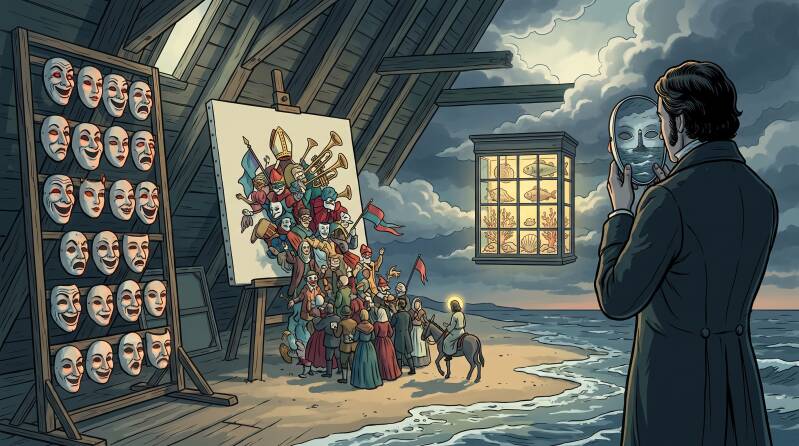
James Ensor (1860–1949) was a Belgian painter and printmaker from Ostend who used carnival masks from his family's souvenir shop to unmask society. For him, a mask was not a disguise but a magnifying glass: it shows what a polite face hides, such as herd behaviour, dogma and hypocrisy. His masterpiece, Christ's Entry into Brussels in 1889 (1888), was first shown in public in 1929.
Ostend, 1888. Downstairs in the shop, shells, chinoiserie, stuffed fish and carnival masks wait for the summer visitors. Upstairs, in the attic of the family home, the air smells of oil paint. There, 28-year-old James Ensor is working on a canvas measuring two by four metres. Across the canvas, a parade floods through Brussels: hundreds of figures, most of them masked. A bishop leads the way as drum major. Somewhere in the middle, small and almost invisible, Christ rides a donkey, wearing Ensor's own face. The canvas is huge, raw and loud. Ensor sells little or nothing in these years, and his father died last year. The family now leans harder on him and on the shop downstairs.
What Ensor does not know, we do. This painting will one day hang in Los Angeles as one of the most famous Belgian artworks in the world. He will wait forty years for the public to see it. And the man mocking bishops here will become a baron himself.
Why did James Ensor paint masks?
James Ensor painted masks because, to him, they were more honest than faces. A mask exaggerates a single trait: greed, fear, stupidity or smugness. What a polite face hides, a mask shouts from the rooftops. The masks literally came from downstairs. At carnival time, locals and tourists bought them in the family shop. Ensor set them among skeletons and puppets in his studio and painted them as if alive.
It had not started that way. After the Brussels Academy of Fine Arts (1877–1880), Ensor painted dark, realist interiors such as The Oyster Eater (1882). Realism is an art movement that shows everyday life as it is, without embellishment. Yet even that was too bold. The Antwerp Salon rejected The Oyster Eater in 1882, as did the art circle L'Essor a year later. Partly in response, Ensor and other young artists founded Les XX ("The Twenty") in 1883, a Brussels circle for progressive art. That year he also painted The Scandalised Masks.
Was James Ensor a Realist, a Symbolist or an Expressionist?
James Ensor fitted no single box. Symbolism was a late-nineteenth-century movement that aimed to show dreams, ideas and emotions rather than visible reality. Ensor's fellow student Fernand Khnopff became one of its leading figures.
Ensor followed his own path. Between 1885 and 1888 he turned from both Impressionism and Symbolism, writes Ensor specialist Herwig Todts. Belgian art philosopher Willem Elias calls him a significant forerunner of Expressionism, art that puts inner emotion above outward likeness.
What does Christ's Entry into Brussels in 1889 show?
Christ's Entry into Brussels in 1889 shows a giant carnival parade in which hardly anyone notices Christ. Ensor painted it in 1888 as a glimpse of the year ahead, on a canvas measuring roughly 2.5 by 4.3 metres. The bishop marches at the front. On a viewing stand, a masked mayor looks on in a blue coat and white sash. Above the crowd hangs a red banner: Vive la Sociale, long live the social revolution. Another sign hails Jesus as King of Brussels.
The sharpest detail is a small sign: Fanfares doctrinaires toujours réussi, dogmatic fanfares always succeed. According to the J. Paul Getty Museum, the owner of the painting since 1987, Ensor was distancing himself from all party politics and all dogma. In Belgium at the time, "doctrinaire" also referred to the moderate liberals. Ensor did not spare his circles either. The Getty identifies the bishop-drum major as the French atheist thinker Émile Littré. On a balcony, figures vomit and relieve themselves over the letters XX: Ensor's own art circle, newly won over to Georges Seurat's pointillism.
Did Les XX reject Christ's Entry into Brussels?
Christ's Entry into Brussels, painted in 1889, was first shown in public in 1929 at Ensor's retrospective in the Palais des Beaux-Arts in Brussels. The sources disagree on what came before. The Getty writes that Les XX rejected the painting; Britannica even claims Ensor was expelled from the group. That last claim does not hold up. According to the Flemish Art Collection, Ensor still opposed, in vain, the dissolution of Les XX in 1893: he had remained a member. How formal the rejection was is unclear.
The members of Les XX were not narrow-minded enemies. Under secretary Octave Maus, they brought work by Monet, Seurat and Van Gogh to Brussels. Beside their scientific colour theory, Ensor's rough canvas looked like a step back. Their logic was sincere.
How did James Ensor criticise Church, King and political parties?
James Ensor most sharply criticised Church, King and parties in his etchings. In Doctrinal Nourishment (Alimentation doctrinaire, 1889), Leopold II sits on a wall between the Church on one side and the liberals, the army and the bourgeoisie on the other. They relieve themselves into the open mouths of their followers. The print also shows the people's demands: universal suffrage, compulsory education and personal military service. These were no fantasies. In 1886 the army had crushed a workers' uprising in Wallonia with deadly force, and in 1889 only men paying enough tax could vote (census suffrage).
In the etching Belgium in the Nineteenth Century (1889), Leopold II looks down like God the Father on a demonstration that soldiers break up. Around his head float lukewarm phrases: 'What do they want?' and 'A little patience.' The king sees his people but does not hear them. That is satire, not a portrait. Leopold II saw himself as the king who would make small Belgium bigger and richer. Ensor aimed less at the man than at a power that no longer listened.
Why did the rebel James Ensor become a baron?
James Ensor became a baron in 1929, the year Christ's Entry finally went on show. King Albert I granted the title. The satirist who had shown Leopold II soiling his people joined the nobility. The irony runs deeper. Until then Ensor had kept his father's British nationality; according to the Flemish Art Collection, he only sought naturalisation in 1929, with the title in mind. After the French Légion d'honneur (1933), several sources say he tried to withdraw his most subversive prints.
He also wore his most famous mask himself: that of the misunderstood genius. He sold little for years, but from 1893 print rooms in Brussels, Dresden and Vienna began buying his etchings. The story that he vainly offered his whole studio for sale in 1893 has never been documented. Art historian Sabine Taevernier argues that Ensor zealously kept the legend of the misunderstood artist alive himself.
A hypocrite? No, a human being: he wanted to be both an outsider and recognised.
What does James Ensor teach us about free inquiry?
James Ensor shows that free inquiry is not a party card but a gaze that spares no camp, your own included. Free inquiry (libre examen) is the principle that every authority and every claim may, and must, be critically tested, without prior dogma. It is the founding principle of the Université libre de Bruxelles (ULB), founded in 1834. Ensor knew that world well. Through the poet Théo Hannon, he joined the liberal circle of ULB professor Ernest Rousseau and Mariette Rousseau-Hannon, a meeting place for artists, writers and scientists.
Still, Ensor never became a party man. He mocked bishops and kings but also doctrinaire liberals, an atheist thinker and avant-garde dogma. In 1909, for the ULB's 75th anniversary, the mathematician Henri Poincaré wrote that thought must never submit: not to a dogma, not to a party. Ensor had painted that sentence more than twenty years earlier. Willem Elias even reads Ensor's grotesque work as a critique of rationalism's blind spots. From a secular humanist view, that is the core: critical thinking also looks inward.
That answers the central question. Put on a mask, and you see what institutions prefer to hide: that authority is often theatre and that crowds like to follow. Yet Ensor's life shows the other side: wear a mask long enough, and you forget it is one.
What do James Ensor's masks mean today?
James Ensor's masks still matter, for we too live in a parade of masks. It is a parallel, not an equation: a filter is not papier-mâché. Yet the mechanism is similar: we show a version of ourselves, and the crowd cheers the loudest voice. Ensor's little sign is still hanging: dogmatic fanfares always succeed. Social media often reward those confirming their camp. Free inquiry asks the opposite. And a second lesson, about Ensor himself: those who unmask others often wear a mask too. Which mask do you wear, and for whom?
Frequently asked questions
Who was James Ensor?
James Ensor (1860–1949) was a Belgian painter and printmaker from Ostend. He is known for grotesque works full of masks and skeletons and is seen as an important forerunner of Expressionism and Surrealism. In 1929 King Albert I made him a baron.
Why did James Ensor paint masks?
James Ensor painted masks because, to him, they revealed people's true nature, such as greed, conformism and hypocrisy. The masks came from his family's souvenir shop in Ostend, where they were sold for carnival. From 1883 onwards they became a recurring motif in his work.
Where is Christ's Entry into Brussels in 1889 today?
Christ's Entry into Brussels in 1889 hangs in the J. Paul Getty Museum in Los Angeles, which bought it in 1987. James Ensor painted it in 1888. It was first shown in public in 1929, at the Palais des Beaux-Arts in Brussels.
Was James Ensor expelled from Les XX?
No, there is no evidence for that. According to the Flemish Art Collection, James Ensor still opposed the dissolution of Les XX in 1893, so he was still a member at that time. His Christ's Entry into Brussels in 1889 was, however, never shown at a Les XX exhibition.
Was James Ensor a freethinker?
James Ensor was neither a party man nor a philosopher, but he did move in liberal circles around ULB professor Ernest Rousseau. Reference works describe him as an atheist who identified with Christ as a mocked outsider. From the secular humanist perspective of this series, we read his work as free inquiry in images: a critique of every dogma, including that of one's own camp.
Sources
- Todts, Herwig (with Cathérine Verleysen and Robert Hoozee), "Biography", James Ensor. An online museumthe Flemish Art Collection, is available at – jamesensor.vlaamsekunstcollectie.be.
- Paul Getty Museum, "Getty Presents The Scandalous Art of James Ensor" (2014) and the object description of Christ's Entry into Brussels in 1889 (via Google Arts & Culture).
- MSK Ghent, collection records for Alimentation doctrinaire (inv. 1998-B-80) and La Belgique au XIXe siècle (inv. 1998-B-81-1).
- Taevernier, Sabine, "Ensor's Agents and Collectors After 1920 and the Liquidation of His Estate upon His Death", Nineteenth-Century Art Worldwide (Summer 2026).
- Elias, Willem, "Het expressionisme" and "De narratieve schilderkunst", in Belgische kunst na '45 – willemelias.be.
- Grant, Kim, "James Ensor, Christ's Entry into Brussels in 1889", Smarthistory / Khan Academy.
- Royal Academy of Arts, "James Ensor: A man of many masks".
- Fondation Vincent van Gogh Arles, biography of James Ensor.
- deMens.nu, annual report 2024 (core values of secular humanism).
Reactie plaatsen
Reacties