

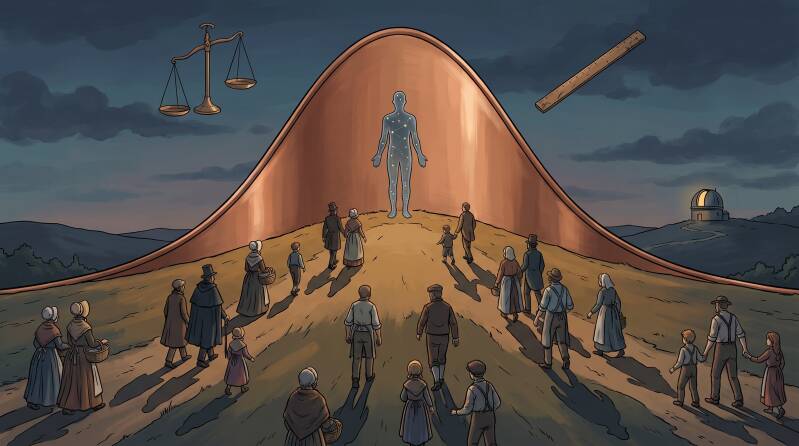
Adolphe Quetelet (1796–1874) was a mathematician, astronomer and statistician from Ghent who introduced the 'average man' (l'homme moyen) in 1835. The average man is a fictional person whose traits are the averages of all measurements taken in a population. With this idea, Quetelet laid the foundations of social statistics and of what we now call the BMI, but he also turned the average into a yardstick against which individuals were judged.
Brussels, the early 1830s. In the city's foundling hospital lie infants whom nobody wanted, or nobody could keep. A man in his mid-thirties measures them one by one: how long, how heavy, boy or girl. He writes down the numbers and moves on to the next child.
The man is Adolphe Quetelet, appointed astronomer of an observatory that has not yet been built. One hundred newborns pass into his columns this way. From those figures he calculates something nobody had quite calculated before: the size and weight of an 'ordinary' baby. There is a bitter irony in that moment. The first 'normal' baby on paper is built from the most vulnerable children in the city. Medical historian Lawrence Weaver points out that these foundlings were anything but representative. Yet for decades, Quetelet's figures remained the standard reference for infant growth.
This is how an idea began that still sits in your doctor's office, your insurance policy and your phone. And it is how the question of this column begins: what happens to the individual once science invents the average?
Quetelet's 'average man': an idea borrowed from astronomy
Adolphe Quetelet borrowed the idea of the 'average man' from astronomy: an imaginary person who combines all the averages of a population into one figure. He developed the idea in his major work, Sur l'homme et le développement de ses facultés, ou Essai de physique sociale (1835), translated into English in 1842 as A Treatise on Man. Quetelet himself compared this figure to the centre of gravity of a body: the point around which everything else oscillates. Astronomy was Quetelet's first love. Astronomers knew that every measurement of a star contains a small error. If you measure often enough, those errors spread neatly around the true value in a bell-shaped curve. The average is then your best estimate of reality.
Quetelet's bold move was to apply that logic to people. Yet a thousand measurements of one star are not the same as a thousand different human beings. Jean-Jacques Droesbeke, a statistician at the Université libre de Bruxelles (ULB), calls this equation 'audacious, even abusive'. Still, it worked remarkably well at making patterns in society visible.
The average as an ideal: the Scottish soldiers of 1846
Adolphe Quetelet did not see the average as a dull middle but as an ideal, and the Scottish soldiers of 1846 became his best-known proof. He treated deviations as errors, in essence: accidental disturbances of a model. For him, the average man was the 'type' of a nation and even a standard of beauty. In 1846 Quetelet published the chest measurements of 5,738 Scottish soldiers and showed that they formed a bell curve around roughly 40 inches. He never measured those soldiers himself: the figures came from an earlier Scottish publication. The American statistician Stephen Stigler later found that Quetelet made quite a few arithmetic errors when adding them up.
His conclusion largely survived. But the episode shows how quickly a tidy average can look more certain than it really is.
1831: Quetelet finds the regularity of crime
In 1831 Adolphe Quetelet discovered that crime returns year after year with striking regularity. That year he published a study on the 'propensity to crime' at different ages. He found that the numbers of murders, forgeries and poisonings barely changed from one year to the next. He summed it up in a sentence that stuck. According to Quetelet, there is a 'budget' that society pays with frightening regularity: the budget for prisons, penal colonies and the scaffold. That budget, above all, he wrote, was the one to reduce.
In his 1835 book he went further. Society, Quetelet argued, contains the seeds of every crime that will be committed; the offender is more like the instrument. That sounds bleak, but he read it with hope. If the causes are social, we can change them: through better institutions, different habits and, above all, education.
Quetelet's numbers and the question of free will
Adolphe Quetelet's crime figures, many contemporaries felt, collided head-on with free will. If you can predict how many people will commit murder next year, where is the murderer's choice? His work triggered a wide debate on free will versus social determinism. Quetelet himself did not deny free will. He described groups, not individuals: in large numbers, individual deviations cancel each other out. That is exactly where the tension lies. A law for a thousand people says nothing certain about the one person in front of you, and yet the temptation to read it that way would prove strong.
Brussels 1853: young Belgium measures itself
Adolphe Quetelet taught young Belgium to measure itself and so gave the new state something it badly needed: reliable numbers and international credibility. In 1841 Belgium created a Central Statistical Commission, and Quetelet chaired it until his death in 1874. One of its first tasks was simple and fundamental: establishing how many people actually lived in the kingdom. In 1853, Quetelet brought the first International Statistical Congress to Brussels. A country not yet twenty-five years old became the meeting point of Europe's statisticians. For an unlikely nation, that was no minor detail. Whoever can count and measure themselves also exists on paper.
Quetelet, Galton and the two faces of the average
From the standpoint of Belgian freethinking humanism (vrijzinnig humanisme), Adolphe Quetelet's legacy has two faces. The first face is liberating. Counting crime instead of explaining it as sin or fate is an act of free inquiry: don't believe, investigate. Quetelet moved the explanation of human behaviour away from the pulpit and from destiny, placing it instead in circumstances that people themselves can change. The second face threatens exactly what humanism values most: self-determination. If the average is an ideal, every deviation becomes an error. Anyone too short, too heavy or simply different is no longer described but judged. The average risked becoming a dogma of its own, written in numbers instead of articles of faith.
That second line reached far beyond Quetelet himself. The British scientist Francis Galton read Quetelet's bell curve and turned his attention to who ranked above and below the average. In 1883, Galton coined the term 'eugenics'. Quetelet did not invent it, but his idea of an ideal norm made that leap easier. Still, it would be unfair to paint Quetelet as a cold number-cruncher. Droesbeke describes him as a cautious man, attached to social propriety, a reformer rather than a revolutionary. He wanted to shrink the budget of the prison and scaffold, not to sort human beings. His mistake was not malice but too much faith in the middle.
From Quetelet index to cockpit: the average man today
Adolphe Quetelet's average man lives on today in the BMI and in the design of everyday things, from clothing to cockpits. The ratio of weight to the square of height that Quetelet described around 1832 was named the 'body mass index' in 1972 by the American physiologist Ancel Keys. Quetelet never meant it as a medical verdict on individuals. Today, that single formula helps determine whether a doctor, an insurer, or an app will label you as 'normal'. A telling counterexample comes from the US Air Force. Around 1950, researcher Gilbert Daniels compared 4,063 pilots with an 'average pilot' across ten body measurements. Every pilot was above average on at least one criterion. A cockpit designed for the average pilot fitted no one.
This is a parallel, not an equation: Quetelet designed no algorithms or risk profiles. But the question he raised is sharper today than ever. The humanist answer is clear: measure by all means, but never let the measurement decide who someone is allowed to be. Who protects the person who falls just outside the curve today?
Frequently asked questions
What does Quetelet's average man mean for the individual?
Once the average becomes an ideal, every individual becomes a deviation from a norm. Adolphe Quetelet used the 'average man' to describe groups, but the idea was later also used to judge individuals. From the freethinking humanist perspective of this series, that is the core problem: a measurement may describe people, but it should never decide who they are allowed to be.
What is Quetelet's 'average man' (l'homme moyen)?
The average man (l'homme moyen) is a fictional person whose traits are the averages of all measurements in a population. Adolphe Quetelet developed the concept in 1835 in Sur l'homme et le développement de ses facultés (A Treatise on Man). He borrowed the method from astronomy and treated deviations from the average as errors.
What did Quetelet discover about crime?
From 1831 onwards, Adolphe Quetelet showed that the number of crimes stays remarkably constant from year to year. He concluded that crime is closely tied to social conditions, which institutions and education can improve. His work fuelled the debate between free will and social determinism.
Why is Adolphe Quetelet important for Belgium?
Adolphe Quetelet (Ghent, 1796 – Brussels, 1874) gave young Belgium reliable statistics and international scientific credibility. He directed the Brussels Observatory from 1832 and chaired Belgium's Central Statistical Commission from 1841 to 1874. In 1853 he brought the first International Statistical Congress to Brussels.
Is Quetelet linked to eugenics?
Adolphe Quetelet did not invent eugenics; the word was coined in 1883 by the British scientist Francis Galton. Galton did, however, build on Quetelet's bell curve and on the idea of a norm against which people are measured. From the freethinking humanist perspective of this series, the risk is that an average shifts from describing to judging.
Did Adolphe Quetelet invent the BMI?
Yes, the formula behind the BMI goes back to Adolphe Quetelet. Around 1832 he observed that adult weight is roughly proportional to the square of height, a ratio long known as the Quetelet index. The name 'body mass index' dates from 1972 (Ancel Keys), and Quetelet did not use the ratio to assess individual overweight.
Sources
- Primary: A. Quetelet, Recherches sur le penchant au crime aux différents âges (Brussels, 1831; 2nd ed. 1833) ; Recherches sur la loi de la croissance de l'homme and Recherches sur le poids de l'homme aux différents âges (Nouveaux mémoires de l'Académie royale de Bruxelles, vol. 7, 1832) ; Sur l'homme et le développement de ses facultés, ou Essai de physique sociale (Paris, 1835) ; Lettres à S. A. R. le duc régnant de Saxe-Cobourg et Gotha, sur la théorie des probabilités (Brussels, 1846).
- J.-J. Droesbeke, Adolphe Quetelet. Passeur d'idées (Brussels, Académie royale de Belgique, 2021) and 'Adolphe Quetelet (1796-1874) – Un scientifique audacieux au service d'une Belgique en quête de crédibilité', Variances (2025).
- S.M. Stigler, The History of Statistics (Harvard UP, 1986); S.M. Stigler, 'Data Have a Limited Shelf Life', Harvard Data Science Review 1.2 (2019).
- L.T. Weaver, 'In the Balance: Weighing Babies and the Birth of the Infant Welfare Clinic', Bulletin of the History of Medicine 84 (2010), 30–57.
- G. Jahoda, 'Quetelet and the emergence of the behavioral sciences', SpringerPlus 4 (2015); L. Grue & A. Heiberg, 'Notes on the History of Normality', Scandinavian Journal of Disability Research 8 (2006).
- G. Eknoyan, 'Adolphe Quetelet (1796–1874) – the average man and indices of obesity', Nephrology Dialysis Transplantation (2008); A. Keys et al., 'Indices of relative weight and obesity', Journal of Chronic Diseases 25 (1972).
- G.S. Daniels, The 'Average Man'? (Wright Air Development Center, 1952), via T. Rose, The End of Average (2016).
- Values framework: deMens.nu and Humanistisch Verbond (free inquiry, self-determination, critical thinking).
Reactie plaatsen
Reacties